What is “blue light?”
Blue light, or HEV-light, is the shortest wavelength in the light spectrum. It has the highest energy and scattering intensity. Almost all gadgets currently emit blue light, as they are backlit using LED and fluorescent lamps.
Most of the blue light that people “consume” comes from the sun. But the main “impact” comes from computers, smartphones, televisions, and other digital devices.
Does blue light affect sleep quality?
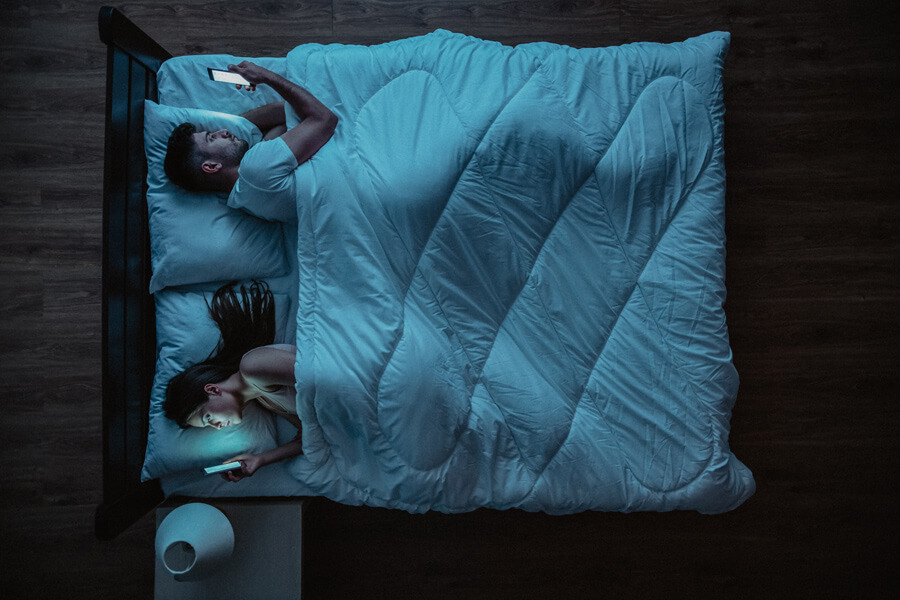
Using smartphones disrupts the body’s circadian rhythms, causing sleep disorders and disruptions in metabolic processes. “Blue screens” reduce the production of melatonin — the sleep hormone — at night and cause insomnia..
The photosensitive cells in the retina react to the intensity of light. If artificial light shines into the eyes at night, when there is no natural daylight, the production of melatonin drops sharply. As a result, the body cannot fall asleep. And regular nighttime vigils in front of the screen can lead to chronic insomnia.
Gadgets and vision
The more often you look at your phone's monitor, the worse your eyesight gets. The screen is constantly flickering, and reading small text, you strain your eyes.
In 2018, scientists proved that high‑energy blue light, whether emitted by the sun or by gadgets, can cause dry eyes, cataracts, and age‑related macular degeneration, as it passes through the cornea and lens to the retina.
Photoaging is the most controversial topic
The research results on this issue vary greatly. Some experiments prove that the blue spectrum of light, like ultraviolet light, has a negative effect on collagen metabolism in the epidermal layers: collagen and elastin fibers are destroyed due to the production of reactive oxygen species. There is less collagen, so the skin ages faster.People with darker skin experienced more swelling, redness, and pigmentation changes after exposure to blue light than people with lighter skin.But there are also other opinions. A candidate of biological sciences from one of the research institutes agrees that blue light penetrates slightly deeper than UV rays. However, blue radiation does not have enough energy to affect DNA and nucleic acids. It can trigger reactions that result in cellular stress, aging, and photoaging. But these changes can only be caused as a result of prolonged, intense exposure. There are no sources of blue light of such intensity in everyday life.
The German company Beiersdorf has drawn similar conclusions. They conducted a study that showed that sitting continuously in front of a monitor for a week, at a distance of 30 centimeters from the screen, is equivalent to just one minute outdoors on a sunny summer day in Hamburg. And a ten‑hour phone call is equivalent to one minute in the sun.
In addition, some dermatologists use blue light to treat certain skin diseases, such as acne. Other risks
There is a high probability of a link between disrupted biorhythms and blood sugar levels, which can lead to diabetes. The hormone leptin, which is responsible for the feeling of satiety, on the contrary, decreases, and as a result, a person will experience hunger even if the body does not need food.
Thus, regular use of gadgets at night can trigger obesity and diabetes.
Harvard suggests that shifting sleep cycles and regular exposure to light at night significantly increases the risk of cardiovascular and even oncological diseases.
There are opinions that phone signals have a negative impact on the reproductive system, so you shouldn’t carry a phone in your pants pocket.
Smartphones are also extremely harmful to the developing and growing brain, so keep them away if you are pregnant or have a small child.
Mobile phones can cause a certain level of addiction. Psychologists are convinced that if a person becomes addicted to a smartphone, they fall behind in life and become aggressive towards those around them.
FACT: the longer you spend holding a mobile phone during the day, the worse it can affect your health.
How to reduce the harm from blue light?
A break before bedtime. Doctors recommend refraining from using any devices with a screen at least two hours before going to bed: smartphones, tablets, TVs, and so on. This time is just enough for the body to produce a sufficient amount of melatonin, so that you can fall asleep peacefully. The ideal option is to go for a walk, and for children, spending several hours outdoors every day is absolutely essential..
Blue light blockers. Lenses or glasses that filter blue light. The simplest option is yellow “glasses”.
As for skincare products sold as protectors, their effectiveness has not yet been proven due to the lack of all the necessary data.
❗️However, using creams with antioxidants (vitamin C) will be beneficial. Vitamin C can help prevent photoaging and treat hyperpigmentation. For example, the BIOFOLLICA serum with vitamin C.
Software tools. Recently, developers of operating systems and firmware have begun to embed software-based blue light emitters in some of them. These modes won’t be a panacea, especially for those who like to spend time on their phones late at night, but they can still help reduce…
Conclusions
Prolonged time spent in front of a smartphone or TV screen does not fit into a healthy lifestyle, but it is the blue‑spectrum radiation that significantly exacerbates the situation. Its impact leads to fatigue and sleep disturbances, at the very least..
It is definitely worth giving up the use of any gadgets a few hours before going to bed, or at least enabling software filters..
Take care of your health and fill your daily routine with pleasant and safe rituals!
With care for you, the BIOFOLLICA team